

USDA Loan Primary Residence Requirements: What Marco's Story Teaches About Occupancy Rules
The Question That Almost Stopped Marco's Homebuying Plans
Marco manages a grocery store in rural Wyoming. His job comes with long hours, and during inventory weeks he sometimes stays at the store past midnight checking stock, sleeping only a few hours before opening again the next morning. He'd been renting a small apartment in town while he and his wife saved for a house big enough for their two young kids. When he finally found the right home, just outside city limits in a USDA-eligible area, he thought the hard part was over.
Then he read the USDA occupancy requirement and panicked. Would his late nights at the store, away from the new house, make him ineligible for a loan that requires the home to be his primary residence?
USDA loan occupancy requirements, in the regulation
The rule is in 7 CFR 3555.151(c): applicants must agree to, and be able to, occupy the home as their principal residence, and the agency may ask for evidence of that ability. USDA will not guarantee a loan on an investment property or on temporary, short-term housing.
Owning a home already does not automatically disqualify you. Under 7 CFR 3555.151(e), a current homeowner can qualify if, among other conditions, the current home no longer meets the household's needs, the new home will be the primary residence, no more than one other single-family home is kept, and the household is financially qualified to own more than one home.
Source: 7 CFR 3555.151(c) and (e), Eligibility requirements, Single Family Housing Guaranteed Loan Program.
A Common Situation for Rural Buyers
This is a situation that comes up often for buyers in rural areas working demanding jobs, whether that's grocery management, ranching, healthcare shifts, or seasonal work. Borrowers hear the phrase primary residence and assume it means they must be physically inside the house every single night of the year, with zero exceptions. That assumption, left unchallenged, can talk a qualified buyer out of applying at all.
What the USDA Guideline Actually Says
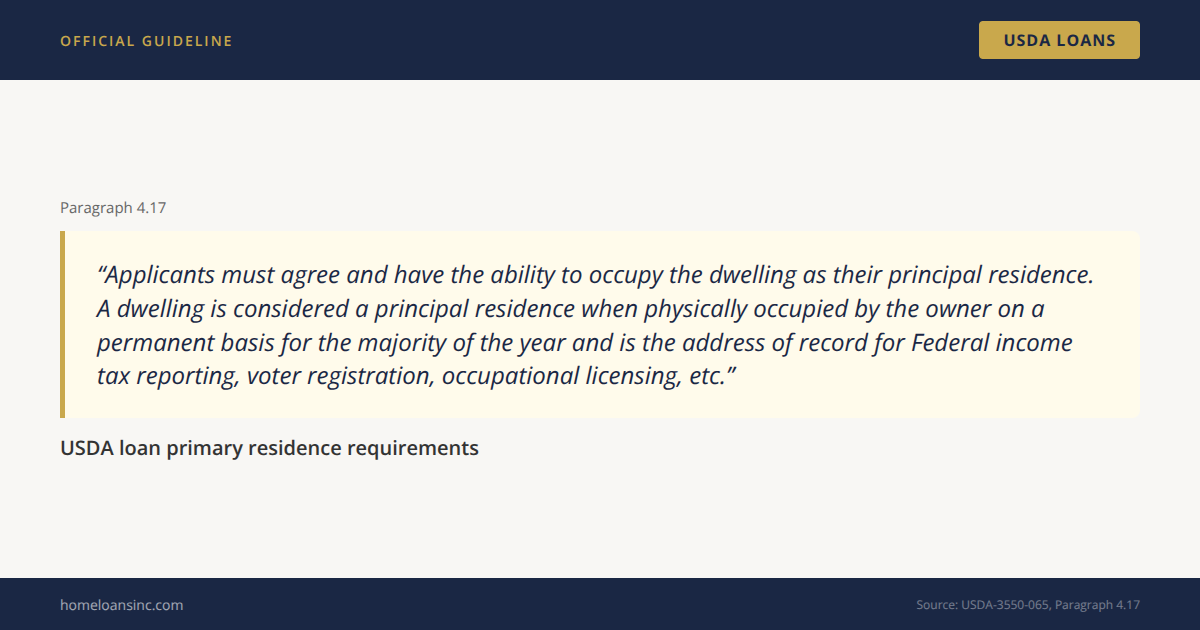
USDA 3550-065, Paragraph 4.17 states: Applicants must agree and have the ability to occupy the dwelling as their principal residence. A dwelling is considered a principal residence when physically occupied by the owner on a permanent basis for the majority of the year and is the address of record for Federal income tax reporting, voter registration, occupational licensing, etc.
Read that carefully. The standard is majority of the year, not every night without exception. The second half of the guideline is just as important: it's about being your address of record. Where you file federal taxes. Where you're registered to vote. Where your occupational license or driver's license lists your address. That's the practical test USDA applies, not a log of every night you spend at work.
Where Overlays Come In
Here's where a lot of confusion starts. Individual lenders sometimes apply their own stricter standard on top of USDA's actual guideline, treating any night away from home as a red flag. That stricter standard is called an overlay. It's not a USDA rule, it's a lender choice, and it varies from one lender to the next.
How This Played Out for Marco
When Marco explained his inventory-week schedule, the concern he ran into wasn't coming from USDA itself, it was an overlay from a loan officer applying a stricter, unwritten standard. As a broker, I'm not locked into one lender's overlay. I have access to multiple USDA-approved lenders, and I moved his file to one that applies Paragraph 4.17 as it's actually written: majority of the year, address of record, not a perfect attendance record at home.
The Takeaway for Rural Buyers
If you work irregular hours, seasonal shifts, or overnight inventory weeks and you're eyeing a USDA-eligible home, don't assume you're disqualified before you ask the right question. Ask your lender to point to where in the guideline they're basing their occupancy concern. Paragraph 4.17 is clear: occasional overnight stays at work don't disqualify you, as long as the home remains your primary address for tax and legal purposes.
Marco kept his job, kept his inventory nights, and closed on the house outside city limits. The guideline was on his side the whole time, he just needed someone to read it with him.